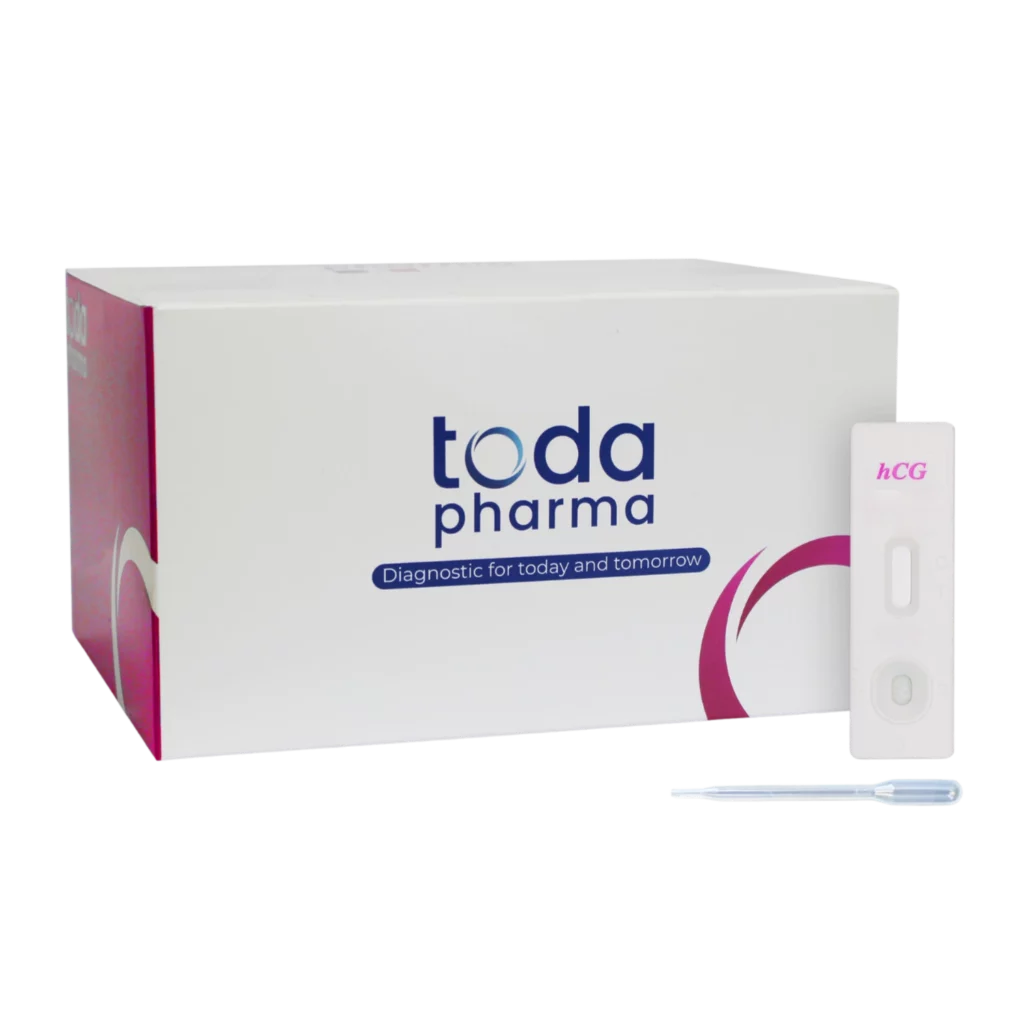
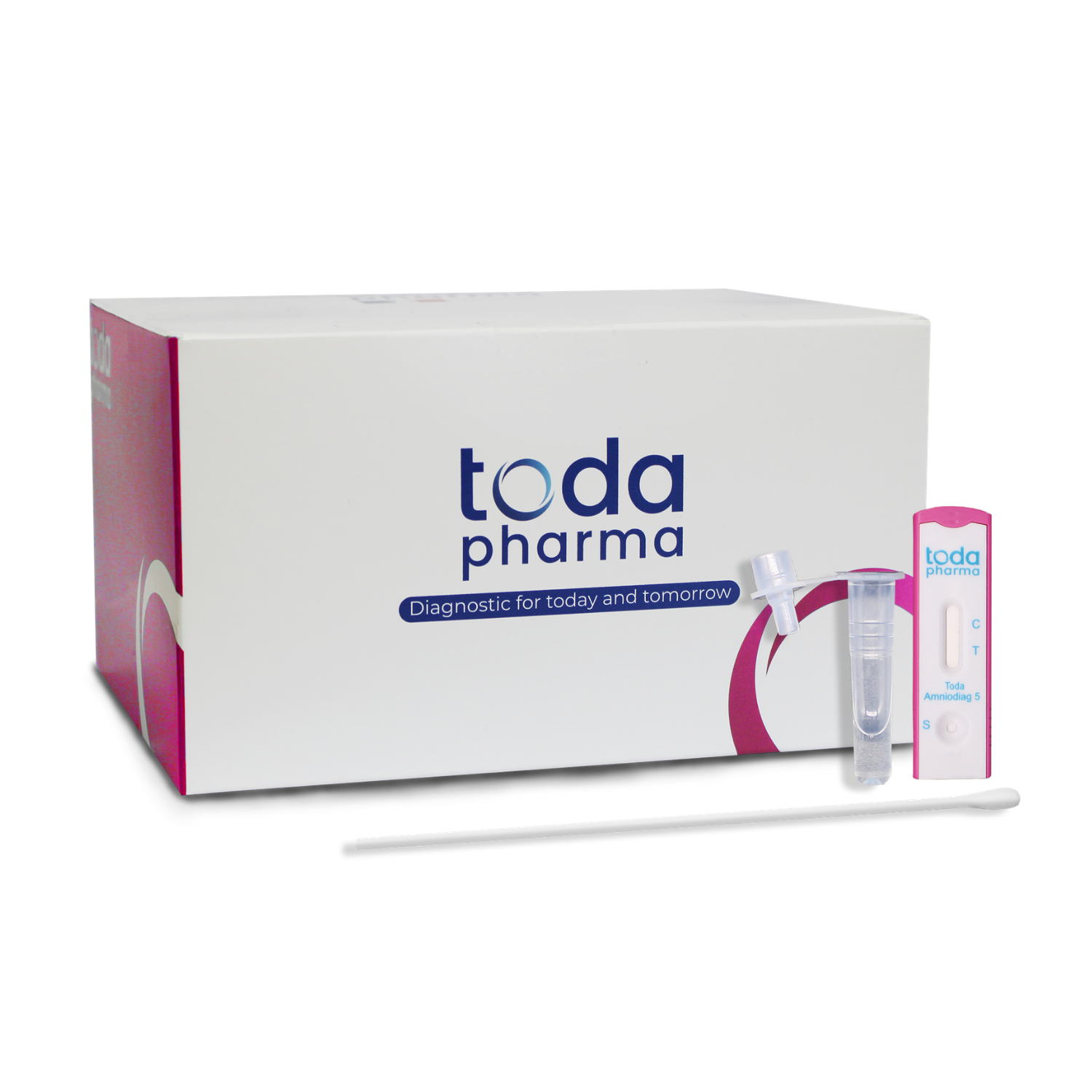
Toda hCG Kit
Rapid pregnancy test in cassette format
ThehCGkit is a rapid chromatographic immunoassay for the qualitative detection of human chorionic gonadotropin (hCG) in urine and aids in the early diagnosis of pregnancy.
- hCG
- From the 3rd week of amenorrhea
-
Interpretation time
5 minutes
-
Sampling
Urine
An accurate, fast, and reliable test
The benefits of the Toda hCG Kit.
RAPID
Results read in 5 minutes.
PRECISE
Sensitivity of 99.9% and specificity of 99.9%
RELIABLE
Pregnancy detection at the expected date of menstruation.
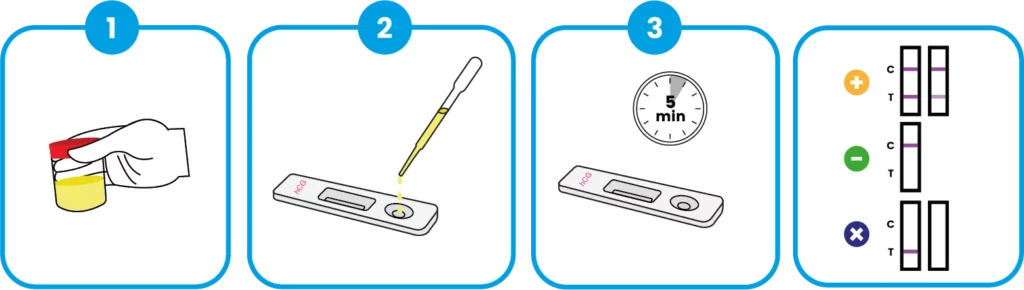
An accurate test starts with proper technique
Learn how to use the Toda hCG kit.
Practical information
All kits contain:
- 25 individually packaged tests
- 25 pipettes
- 1 detailed instruction leaflet
References
- 1028
The test should be stored at room temperature (between +2 and +30 °C).
Helpful documents
Catalog & product sheet
Obstetrics and gynecology catalog
Toda hCG Kit Product Sheet
For any additional information requests
"*" indicates required fields
Learn more
1. How does a pregnancy test work?
A urine pregnancy test detects the presence of the hCG hormone (human chorionic gonadotropin), which is produced by the body after fertilization, as soon as the embryo implants in the uterus.
- After fertilization, the embryo implants in the uterine wall. From this point onward, the hCG hormone begins to be produced by the placenta.
hCG passes into the bloodstream, then into the urine. It becomes detectable approximately 7 to 10 days after fertilization, with rapidly increasing concentrations.
The test contains hCG-sensitive antibodies. When they come into contact with urine containing the hormone, a reaction occurs, causing a line (or symbol) to appear in the result window.
2. What is the usage of pregnancy tests in France?
In France, pregnancy tests are an integral part of the private lives of millions of women. Their use is frequent, early… and sometimes surprising! Here are some key figures that illustrate their role in daily life.
50 %
of women of childbearing age (15-49 years) perform at least one test per year.
60 %
of users take the test before or on the expected day of menstruation, out of mere suspicion.
34 %
of women admit to having taken a test « just for reassurance », without an actual delayed period.
15 %
of women report having taken a pregnancy test secretly, without informing their close circle.
3. Can stress skew the result of a pregnancy test?
No, stress does not alter the result of a urine pregnancy test.
A test's operation relies solely on the presence or absence of the hCG hormone in the urine.
What stress can influence:
- The menstrual cycle: intense stress can delay ovulation or cause a slight delay in menstruation, which can sow doubt (apparent delay).
- The timing of the test: due to stress, some women take a test too early, before hCG levels are detectable.
However, stress cannot create a « false positive ». If the test is positive, even faintly, there is indeed hCG in the urine — indicating an early pregnancy or another medical cause (rare).

4. Is the test reliable if I have consumed a large amount of water?
Not always. Consuming a large amount of water before a test can skew the result.
Water dilutes urine, which can lower the concentration of the hCG hormone (the one detected by the pregnancy test). If the level is still low (very early in pregnancy), this can result in a false negative, even though the person is pregnant.
For reliable results:
- Take the test using your first morning urine, as it is more concentrated.
- Avoid drinking large amounts of liquid within two hours before taking the test.
- If the result is negative but you still have doubts, take another test 48 hours later: hCG levels double every 2 to 3 days.
Complementary diagnostics in this range
-
Obstetric Diagnosis
Toda Amniodiag®5
Test for the detection of premature rupture of fetal membranes (PROM test)Discover
Need information, training, or a quote?
Tell us what you are looking for, and we will promptly provide a tailored solution.