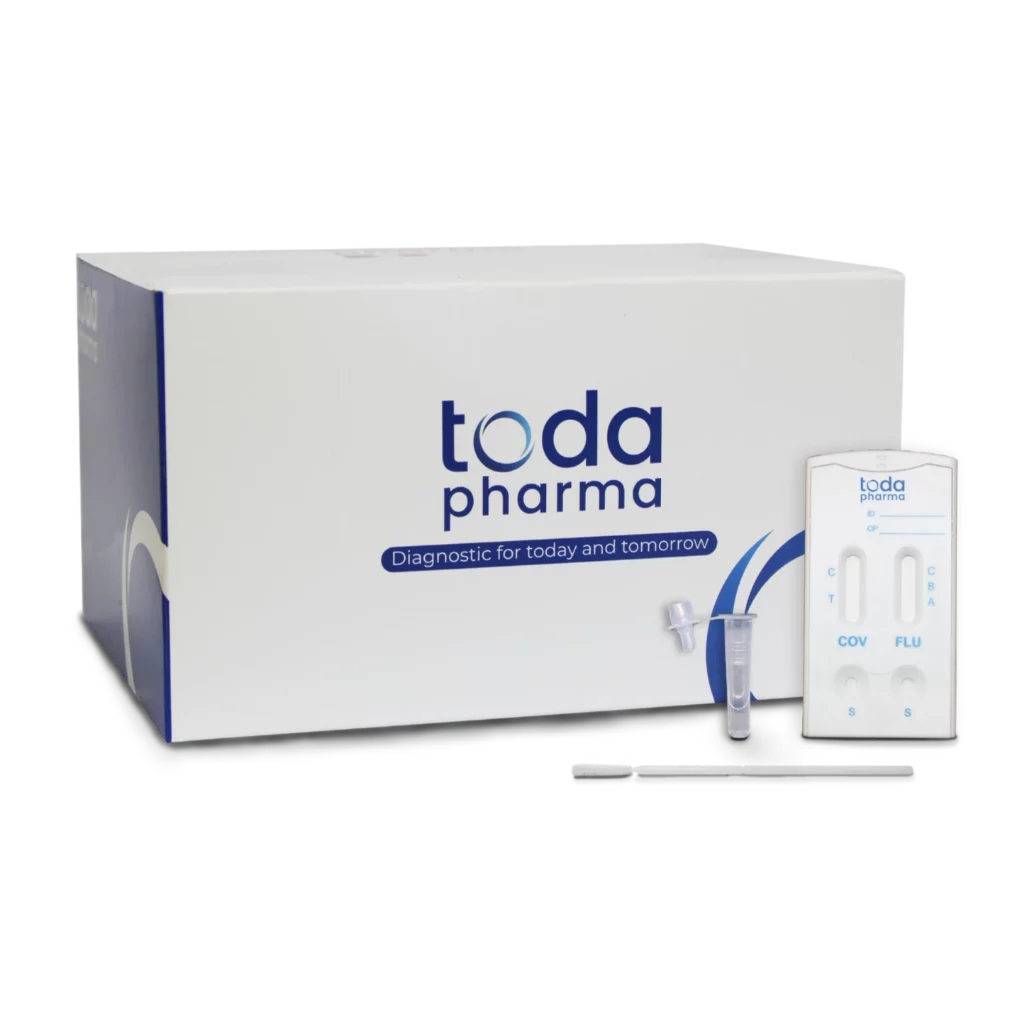
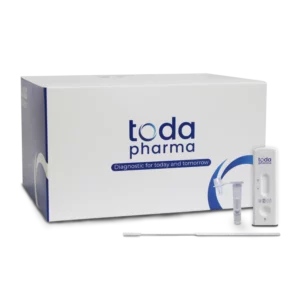
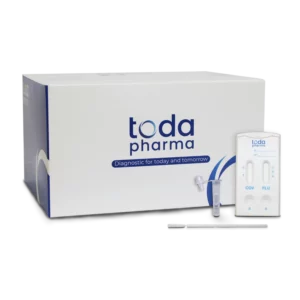
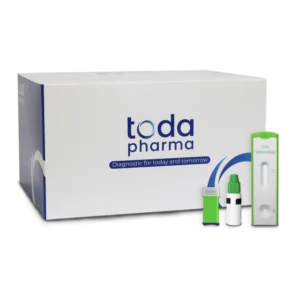
Toda Fluronadiag
Test de diagnostic rapide des virus de la grippe de type A&B et de la COVID-19
Toda Fluronadiag est un test de diagnostic rapide pour la détection qualitative des antigènes de la COVID-19 et des virus de la grippe de type A&B dans des échantillons d’écouvillons nasopharyngés.
- SARS-CoV-2 (COVID-19)
- Influenza A&B
-
Interpretation time
15 minutes
-
Sampling
Nasopharyngeal swab
A rapid, accurate, and convenient test
Les avantages du Toda Fluronadiag.
MULTI-DETECTION
Simultaneous analysis of COVID-19 and influenza A & B viruses in a single test, enabling differential diagnosis.
CONVENIENT
Individual, ready-to-use buffer vials and a single-use diluent included for each test, limiting contamination risks.
EFFICIENT
Contributes to appropriate interventions and optimized care.
ACCURATE, SENSITIVE, AND SPECIFIC
See performance table below.
Performance
| PERFORMANCE | COVID-19 | INFLUENZA A | INFLUENZA B |
| Sensitivity | 96.08% | >99.9% | >96.0% |
| Specificity | 99.5% | >99.9% | >99.9% |
| Accuracy | 98.9% | >99.9% | >99.0% |
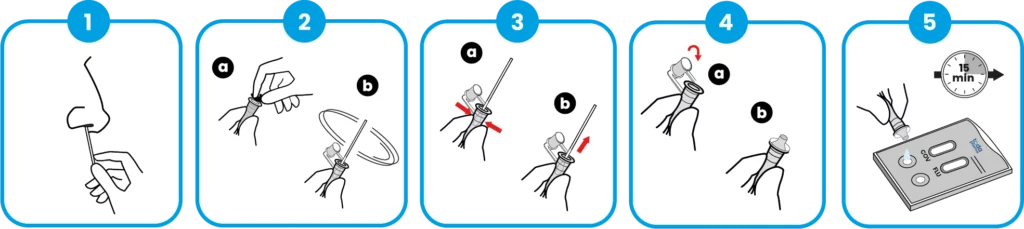
An accurate test starts with proper technique
Découvrez en 5 étapes simples comment utiliser le Toda Fluronadiag.
Practical information
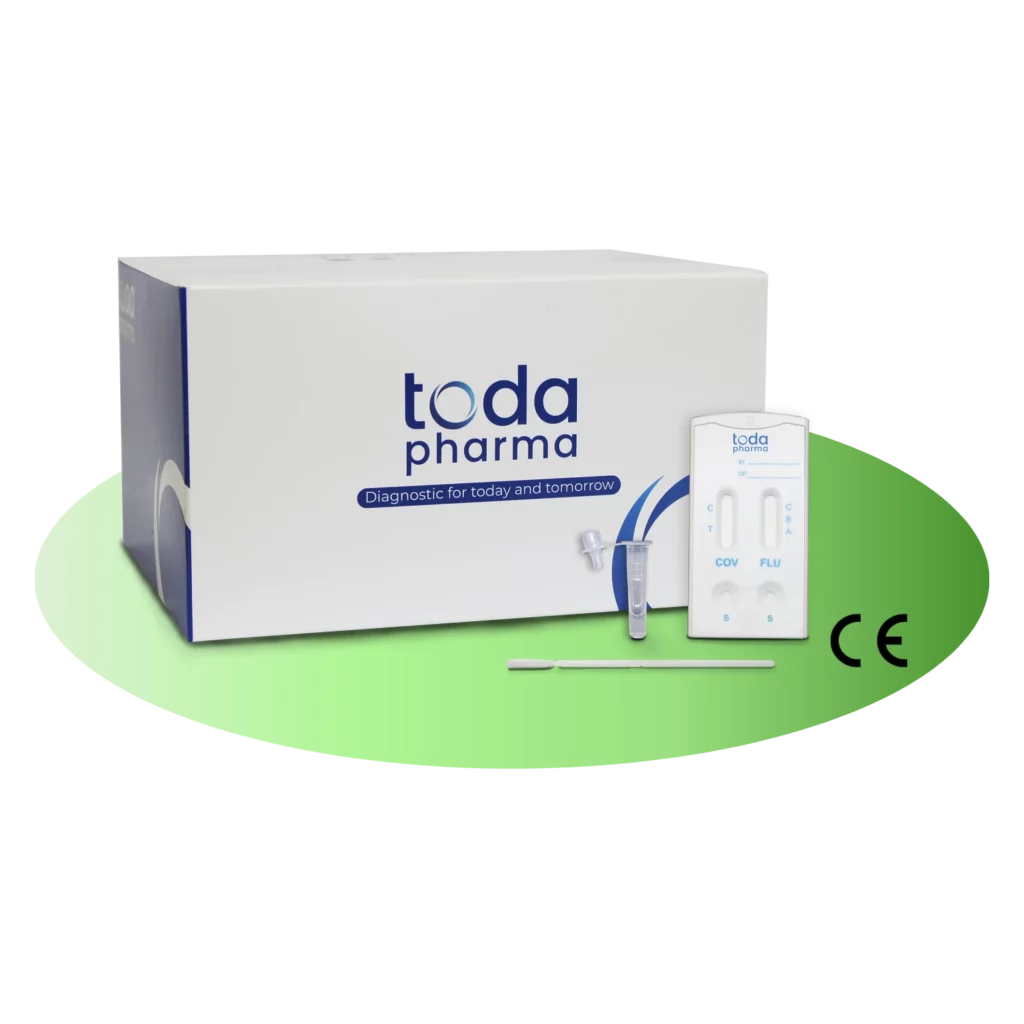
Tous les coffrets Toda Fluronadiag contiennent :
- 10 ou 20 tests au format cassette
- 10 ou 20 écouvillons
- 10 ou 20 flacons de diluant
- 1 detailed package insert
References
- Box of 10 tests: 24CO2-10
- Box of 20 tests: 24CO2-20
- Single test: 24CO2-1
The test should be stored at room temperature (between +2 and +30 °C).
Helpful documents
Catalog & product sheet
Infectious Diseases Catalogue
Fiche produit Toda Fluronadiag
For any additional information requests
"*" indicates required fields
Learn more
1. Why is it important to differentiate between COVID-19 and influenza A & B?
COVID-19 and influenza A and B viruses exhibit very similar symptoms: fever, cough, fatigue, respiratory discomfort, etc. However, they are caused by different viruses and require distinct management approaches.
Differentiating between these infections allows for:
- Prescribing appropriate treatment: the antivirals used differ depending on the causative virus.
- Avoiding unnecessary prescriptions: particularly antibiotics, which are ineffective against viruses.
- Implementing appropriate isolation measures: to limit transmission, especially in high-risk environments (hospital, nursing home, daycare, etc.).
- Ensuring improved epidemiological surveillance: to adapt public health responses.
- Adapt patient communication: to reassure them or, conversely, to expedite their care.
This distinction is particularly crucial during winter periods, when these viruses co-circulate and co-infections are possible.
2. Why perform a test that detects two viruses simultaneously?
The COVID-19 and influenza (Influenza A & B) viruses cause very similar symptoms: cough, fever, fatigue, nasal congestion, respiratory discomfort... It is therefore virtually impossible to determine visually which virus is responsible, especially during winter when these viruses co-circulate.
Instead of performing two separate tests, the Fluronadiag test allows for:
- Saving time (results for all 3 viruses in 15 minutes)
- Reducing patient discomfort (only one nasal swab is required)
- Limiting costs and consumable usage
- Improving immediate patient management (guidance, isolation, treatment)
Furthermore, the test detects co-infections, meaning the simultaneous presence of multiple viruses, which can occur in children or elderly individuals and may exacerbate the illness.
Thus, it is a rapid, efficient, and comprehensive triage tool, particularly valuable in emergency departments, pediatrics, community medicine, or communal settings (nursing homes, nurseries, hospitals).

3. Is it possible to be infected with multiple viruses simultaneously?
Yes, it is entirely possible to be simultaneously infected by multiple respiratory viruses, such as COVID-19 and influenza. This phenomenon is referred to as a co-infection.
Co-infections are particularly common among:
- Young children, whose immune systems are still immature
- Elderly or immunocompromised individuals
- Hospitalized or institutionalized patients, who are exposed to multiple viruses simultaneously
Having multiple viruses simultaneously can make symptoms more severe, complicate diagnosis, and increase the risk of respiratory complications, especially in vulnerable individuals.
Complementary diagnostics in this range
-
Diagnosis of Infectious Diseases
Toda Infludiag A&B
Rapid diagnostic test for Influenza A and B virusesDiscover -
Diagnosis of Infectious Diseases
Toda Fluronadiag
Rapid diagnostic test for COVID-19 and Influenza A&B viruses.Discover -
Diagnosis of Infectious Diseases
Toda Coronadiag Inc.
Rapid diagnostic test for the detection of SARS-CoV-2 antigens.Discover -
Diagnosis of Infectious Diseases
Toda Tetanusdiag
Rapid diagnostic test for tetanus immunization statusDiscover
Need information, training, or a quote?
Tell us what you are looking for, and we will promptly provide a tailored solution.